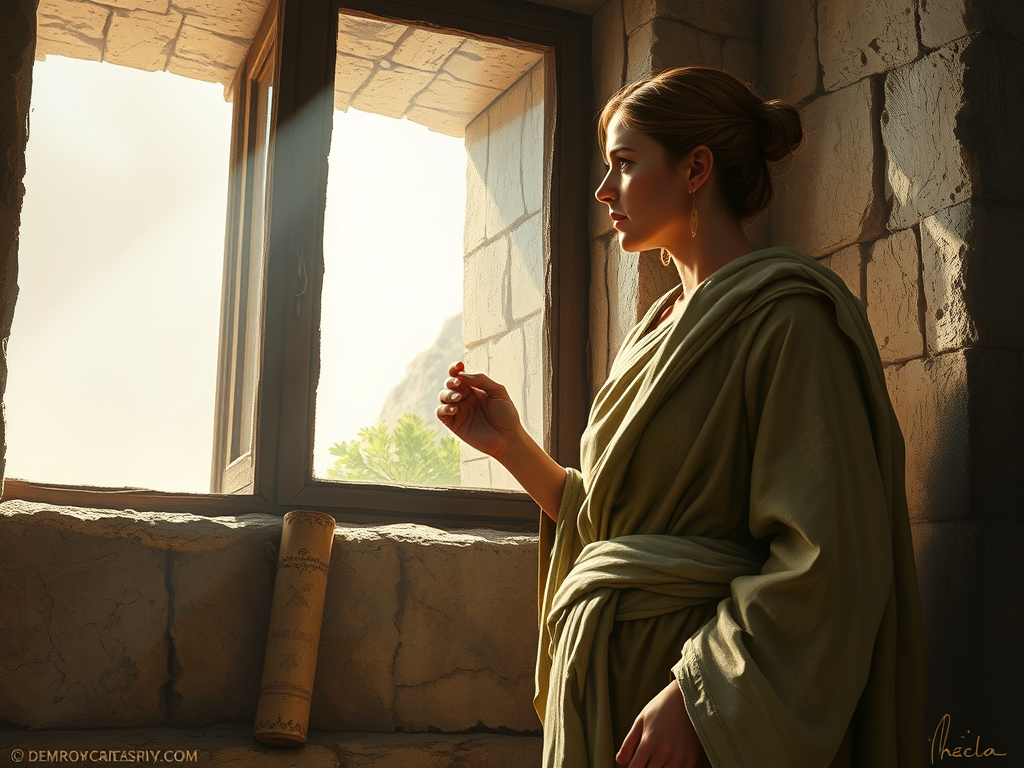


There are names in the early church that many people recognize. Names like Peter, Paul, and John are familiar. But there are other names—important names—that most people have never heard. One of those is Thecla.
Her story is not found in the Bible, but it was widely known in the early church. It comes from a writing called the Acts of Paul and Thecla, a second-century text that tells the story of a young woman whose life was changed by the message of Christ. For many early believers, this was not a strange or hidden story. It was part of the way they understood faith, courage, and leadership.
Today, Thecla is mostly forgotten. But her story raises an important question for us now, just as it did then: what role should women play in the life and leadership of the church?
Thecla lived in a city called Iconium. She came from a family that likely had wealth and status. She was engaged to be married, and her life seemed set on a clear path. But everything changed when she heard the teaching of Paul the Apostle. He spoke about devotion to Christ, about living a life set apart, and about placing God above everything else.
Thecla listened carefully. In fact, she listened for days. The story says she sat near her window, taking in every word. And then she made a decision that shocked everyone around her. She chose not to marry. She chose instead to follow Christ fully.
That decision may not sound extreme today, but in her time it was a direct challenge to social order. A woman was expected to marry, to support a household, and to follow the direction of her family. To refuse that path was seen as rebellion, even dishonor. Her family was upset. Her fiancé was angry. The community turned against her.
Still, she did not change her mind.
Because of her choice, Thecla was arrested and put on trial. She was pressured to give up her new beliefs and return to her old life. She refused. The story tells us that she was sentenced to death, first by fire. But when the moment came, a storm broke out and put out the flames. She survived.
Later, she was brought into an arena and faced wild animals. Once again, she did not back down. And once again, she survived. The story says that the animals did not harm her, and that even a lioness stood beside her rather than attacking.
Whether someone reads these moments as literal history or as symbolic storytelling, the message is clear. Thecla was unwavering. She was willing to face death rather than turn away from her calling.
But what makes her story even more important is what happens next.
She does not return to a quiet life. She does not step back into the background. Instead, she steps forward. She begins to teach. She travels. She shares the message of Christ with others. In one part of the story, she even baptizes herself in a moment of danger, showing a deep sense of personal calling and authority.
This is where Thecla becomes more than just a story of courage. She becomes a picture of leadership.
In the early church, she was not seen as an exception to be ignored. In some traditions, she was honored as “equal to the apostles.” That is a strong statement. It tells us that early Christians saw in her something real. Something important. Something worth remembering.
And yet, over time, her story faded.
As the church became more structured, leadership roles became more defined. Traditions developed. Lines were drawn. In many cases, those lines limited the role of women in teaching and leadership. Stories like Thecla’s did not disappear completely, but they were no longer central.
This raises an important point. The early church may have been more open to female leadership than later generations. When we read the New Testament, we see glimpses of this. Women like Priscilla were involved in teaching. Phoebe is called a deacon and trusted servant of the church. Junia is described as outstanding among the apostles.
In Romans 16, Paul lists many leaders, and a surprising number of them are women. These are not minor roles. These are active, meaningful contributions to the life of the early church.
Thecla fits naturally into this world. She is not out of place. She is part of a larger pattern.
And that pattern should matter to us.
Because the question of women in leadership is not just a modern issue. It is rooted in the earliest days of the church. It is part of our history.
When we look at Thecla’s story, we see more than just a dramatic life. We see a woman who heard the message of Christ and responded with full commitment. She did not wait for permission. She did not shrink back because of social expectations. She stepped into her calling.
That kind of faith should be recognized. That kind of leadership should be valued.
At the same time, we need to be honest. The church today is still divided on this issue. Some traditions fully support women in leadership. Others place limits on what roles women can hold. People on both sides often believe they are being faithful to Scripture.
But stories like Thecla’s remind us that the conversation is bigger than we sometimes think.
They remind us that women were not silent in the early church. They were active. They were bold. They were leaders.
And that brings us to an important conclusion.
Women can and should lead in the church.
Thecla’s story does not stand alone, but it does make something clear. From the beginning, women responded to the call of Christ with courage and leadership. They taught. They served. They took risks. They helped build the church.
To limit that today is not just a question of tradition. It is a question of whether we are fully recognizing the gifts and calling that God has placed in half of the church.
Paul himself writes a powerful statement in his letter to the Galatians. He says that in Christ, there is no Jew or Greek, no slave or free, no male and female. This is not just a spiritual idea. It speaks to identity, value, and belonging in the body of Christ.
If that is true, then leadership should reflect it.
The church has often followed culture instead of leading it. But this is an area where the church has an opportunity to lead. To show that men and women are both called, both gifted, and both needed in leadership.
Equal representation in church leadership is not about keeping up with society. It is about being faithful to the full picture of the early church. It is about recognizing what has always been there.
Thecla’s story is a reminder of that.
She is a voice from the past, calling us to think again. To look again. To remember.
And maybe, to move forward with a clearer vision of what the church can be.
Some of my other musings on the subject of women in church leadership:
The Female Early Church Leader You Should Know! – John Wheeler
Leave a Reply